
 If you’d told sixteen-year-old me that future me would become a pharmacist, working at a community pharmacy, I would have been delighted.
A respectable, high paying (at the time) job, helping others and keeping in touch with the latest scientific developments was everything I was aiming for.
If you’d then told me I would graduate from pharmacy school only at 31 years old – after another degree plus ten years as a pharmacy technician, and that I would have a newborn in my arms – I would start to question your sanity.
If you’d ended the story by telling me that I wouldn’t want to work as a respectable pharmacist in a safe job and would have instead chosen to start a career in a semi-obscure field, working as a freelance medical writer – well, I would smile politely and walk away from you. Slowly.
The wondering pharmacist
I entered my pharmaceutical sciences course knowing I would like to have more options than to work behind a pharmacy counter.
While I liked to bridge the gap between scientific knowledge and information that patients understand, there were many things that started to grate my nerves.
Those things were not related to communication or the human connection with other people, but with management issues, so I started looking for careers in the pharmaceutical industry.
I’d always liked the drug development process, and some of my colleagues had found roles as clinical research associates (CRAs), working in clinical trials. They’d said it was a fast-paced industry, with potential of career development, so I decided to do the same.
I applied for a few roles and enrolled in a CRA course aimed at medical and scientific professionals that wanted to increase their chances of getting hired. In the lecture about clinical trial protocols, the instructor had a job title I’d never heard about: medical writer. Hmm.
Work-life balance
When I finished the CRA course, I faced a challenge that many people have when they try to enter the market.
It’s hard to get a job when you have no experience.
It’s hard to get experience if you don’t have a job.
Internships are one way to get experience, but they’re not easy to get into when you’re over 30 years old.
An unpaid internship would also mean I’d have to leave my paid job. Not ideal.
I was also finding out that some roles, like CRA or medical science liaison (MSL), require frequent travel.
At that point in my life, having small children, I knew I would prefer to stay close to home.
I decided to learn more about that mysterious role I’d heard about in the CRA course, connected with some medical writers through LinkedIn, and asked them some questions:
- How did they become a medical writer?
- Did they like being a medical writer?
- What advice would they give someone trying to get into medical writing?
All the medical writers in my network were extremely helpful, giving me resources to explore and a word of encouragement.
To continue this tradition, I make a point of replying to every message aspiring medical writers send me.
Slowly, I started to think that it was possible to combine working at home as a medical writer and having enough flexibility to spend more time with my family. I knew this would require a plan, hard work and some helpful resources.
Learning how to write
My time in university taught me how to read scientific papers and understand medical jargon.
Through my pharmacy work, I learned how to communicate complex science in simpler terms.
But I didn’t know how to write a medical news article or a blog post. While I knew the types of documents that a clinical trial requires, I wouldn’t know where to begin if I had to write one.
I also needed some reassurance – someone to tell me that I could write. That may seem foolish, but writing is a personal endeavour, and we often feel exposed when we show our work to the world.
Thankfully, writing is a learnable skill, and one that gets better with practice, So, I scoured the internet for online or local courses where I could learn the basics of medical writing.
I started with Coursera’s Writing in the Sciences, a well rounded and comprehensive course. It’s mostly aimed at academic writing, but it also teaches how to edit ruthlessly (a necessary evil for most writers) and how to write a news article.
Next, I found Health Writer Hub. The Introduction to Health Writing course was perfectly timed, and Michele’s encouraging feedback was the nudge I needed to start calling myself a medical writer.
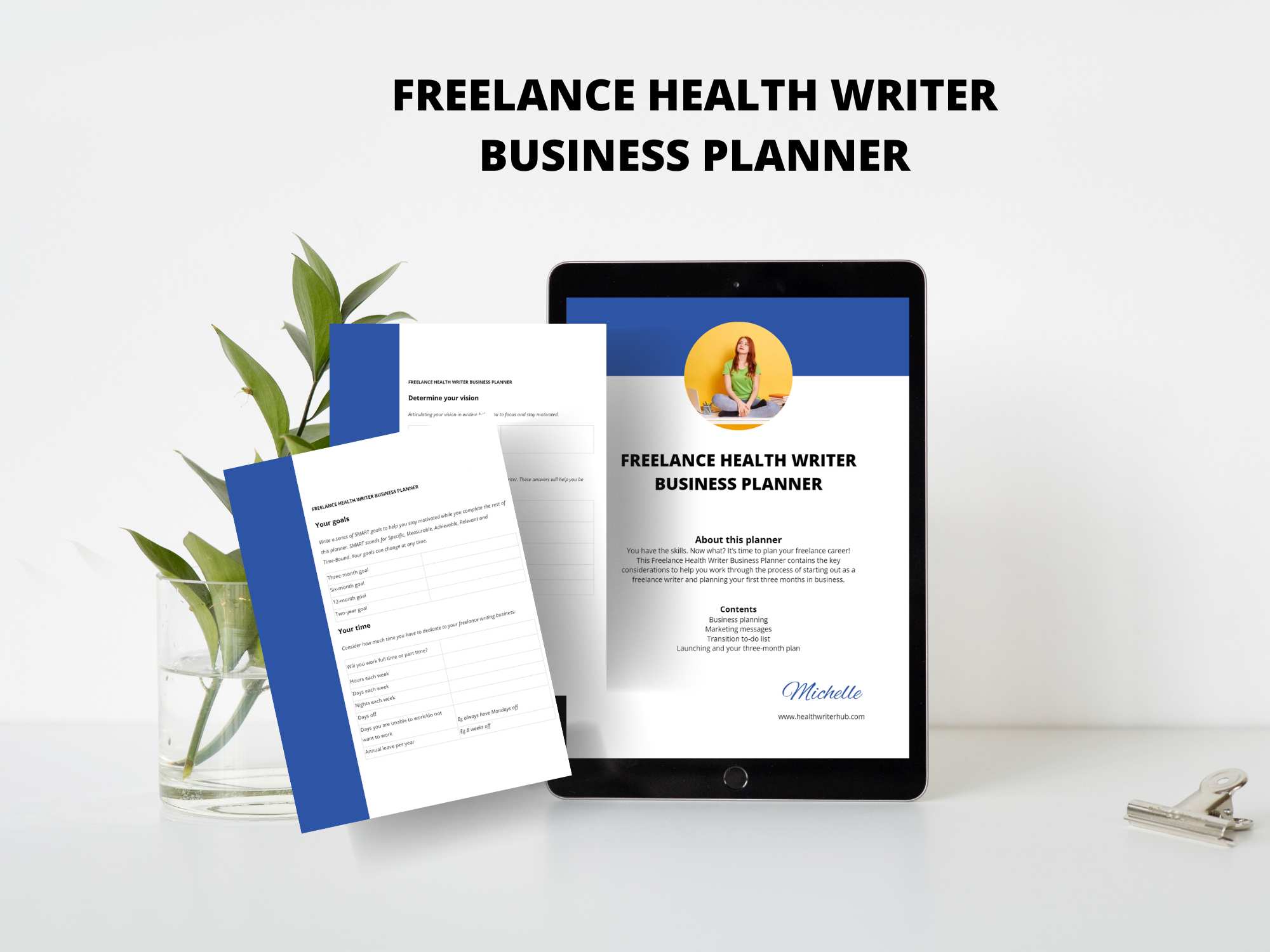
You have the skills. Now what? It’s time to plan your freelance health writing business launch!
If you want to become a freelance health writer but aren’t sure how to get started, this Freelance Health Writer Business Planner is the tool you need.
The planner helps you determine your career transition plan, marketing messages, target clients, writing services and more!
Life as a freelance medical writer
Usually, freelancers work for some years in a pharmaceutical company or in a contract research organization (CRO) before going out on their own.
By then, they have mastered the basics, know how long it takes them to produce each document, and have contacts that can pass on work.
I had none of that.
To overcome these obstacles, I joined the European Medical Writers Association (EMWA).
This professional organization provides education, resources, and networking opportunities to its members.
During 2019, I attended the two conferences EMWA holds, in May and November.
This allowed me to participate in several workshops and, more importantly, to network with other medical writers, both seasoned and newbies like me.
The environment at these conferences is very relaxed, and everyone is nice and keen to help fellow writers.
After a while, I wrote my first article for the association’s journal. I co-wrote it with another medical writer that I contacted through LinkedIn and which is now my virtual friend and colleague.
When his company needed a proofreader with knowledge of English and Spanish on short notice, he put my name forward and I did that project.
Through interaction with another medical writer and colleague in the EMWA webinar team, I got the chance to make a trial for a local branch of an international medical publishing company.
They liked my work and I am now waiting for some regular projects from them.
Networking has been the main way for me to find work.
Networking has also led to meaningful connections and good conversations, an important aspect for those who don’t have co-workers to chat with.
There are also other ways to find work, of course.
I have a profile on Kolabtree and I’ll soon invest in some niche freelance directories, but so far what has worked for me is networking, volunteering for EMWA, and having a newsletter that showcases my writing style.
What now?
My journey as a freelance medical writer has just begun. I’ll keep learning about writing, new developments in drug development, and my new passion: medical devices.
I hope my story helps you draw inspiration for your own path.
