Guest post spam is an inevitable downside of running a blog.
It doesn’t matter if you’re a freelance writer with a blog or a dedicated health and wellness blogger. As long as you have a contact form, you’ll be sent endless requests from people wanting to submit guest posts.
While at the beginning you may feel flattered (You want to write for little old me? Really?), the harsh reality is these people aren’t interested in your blog at all.
They haven’t been reading your work for some time, and they don’t find your content valuable. Sorry.
They’re actually only interested in ‘link building’ – that is, writing a post containing a link to whatever website it is they’re trying to promote.
Why do they bother?
Link building can supposedly help with SEO and increase Google search rankings to the websites these spammers are trying to promote.
However, Google software engineer Matt Cutts argued way back in 2014 that guest blogging as a link-building strategy was dead.
“In general I wouldn’t recommend accepting a guest blog post unless you are willing to vouch for someone personally or know them well. Likewise, I wouldn’t recommend relying on guest posting, guest blogging sites, or guest blogging SEO as a linkbuilding strategy,” he wrote.
Unfortunately, these spammers still haven’t got the memo.
Legitimate guest blogging
If you’re reading this as someone who does want to guest blog, don’t panic.
There’s nothing wrong with guest blogging when it’s done in a credible, authentic way – Matt Cutts himself said this, too.
“There are still many good reasons to do some guest blogging (exposure, branding, increased reach, community, etc.),” Cutts argued. “Those reasons existed way before Google and they’ll continue into the future. And there are absolutely some fantastic, high-quality guest bloggers out there.”
I have written guest posts in the past – as I’m sure many of you have, too. But, for me, the link back to my website isn’t the main drawcard for guest blogging. Sure, it’s a benefit – but it’s not the only reason.
My reasons for guest posting are:
- getting my information in front of a targeted audience
- raising awareness of Health Writer Hub
- providing helpful, relevant content to a niche audience
- doing something a little different, and getting out of my comfort zone.
The key to guest blogging is to send in a genuine pitch with a relevant idea that helps the intended audience.
An included link might then drive the readers to your website while they’re actually reading your post, so they can choose to journey to your site and learn more about you, your products or your services.
But it seems the link won’t really help your website to rank better in an organic search result (spammers take note).
How can you recognise guest post spam?
If you’re new to this type of email, you might not realise what it is at first.
Here are the trademarks of my guest post spammers:
- They refer to my URL instead of my website or blog name – ‘Hey, I’d love to write for https://www.healthwriterhub.com/’
- The email begins with ‘Greetings’ – non-bots do not begin emails with ‘Greetings’
- The email begins with ‘Dear Sir/Madam’ – it’s not hard to work out I am not a Sir since my name and picture is on every page of my website
- The email is overwhelmingly generic – there’s no specific mention of me or the theme of my blog
- They have fake-sounding, very common names – and when I search for them on LinkedIn nothing comes up
- They use Gmail – or Hotmail, or Yahoo (not always an indicator of a spammer, but an additional clue if other signs are there)
- The email addresses contain different names to the name in the email – they call themselves Liz Ryan but their email address is briansmith@gmail.com
- The proposals aren’t relevant – they ask to submit articles about topics that have nothing to do with my website or blog
- They misspell my website name – probably because the site name has been plonked in there by automated software
I receive these guest post spam emails EVERY WEEK
I’m not kidding (I wish I were). If I only receive one per week, it’s been a good week.
Thankfully, as health & medical writing is a niche topic, it’s very easy for me to work out whether a request is legitimate or not.
Of all the guest post spam emails I’ve received, not ONCE has anyone offered to write about health & medical writing.
Examples of guest post spam
The following are examples of emails I’ve received in the past few weeks.
Example #1: Generic copy & paste URL
Dear Sir/Madam,
I am Liz, a Content Marketing Manager. I am a writer and a language tutor with 15 years of experience. I write for the Huffington Post, Business Week, LinkedIn, the Harvard Business Review, the Denver Post, Forbes.com and many more top rated websites.
I am writing you to wonder if I can contribute an article for publication on your website – https://www.healthwriterhub.com/.
I believe I can add value to your audience on a few different topics, and so I’ve included those topics I think would really resonate with your readers here:
- 3 Things to Watch for in Changing Health Care Landscape
- Is There a Career Difference Between Healthcare Management and Healthcare Administration?
- Roles of Women in Academic Leadership
- 5 Unique Benefits of Working in Healthcare 5. Top 5 Reasons: Why Health Workers Must Follow Universal Precautions
You can suggest your own interpretation of the topic, if you want to, or send me any other requirements to the topic/article I could write for you. I would really love to make my own contribution and attract new audience.
Kindly check my sample works:
Example #2: Concise attempt at flattery
Greetings,
I’m a writer and blogger in the healthcare industry. I’ve been following your blog for quite some time now, and I love your content and the information you share with your readers. Every time I read a post, I feel like I’m able to take a single, clear lesson away from it, which is why I think it’s so great.
I’m reaching out to see if you’d be interested in featuring a guest post. I believe I can add value to your audience on a few different healthcare topics.
I’ll greatly appreciate your prompt response in order to get back to me.
Example #3: Irrelevant, poorly written pitch
Myself from India wanted to become active partner by submitting well researched content for your website healthwriterhub.com. I have good experience in constructing innovative content related to health. The aim is to develop unique and interesting content which can attract the visitors. Our goal is to provide high-quality content that can naturally attract traffic and links. This way we both win!
Few of my recently published articles: ‘Ten things you do that are preventing you from losing weight’, ‘Doctors now prescribing music for heart ailments’, ‘Many ways of using gadgets for weight loss’ (got almost 500 shares)
Health Writing Template Package
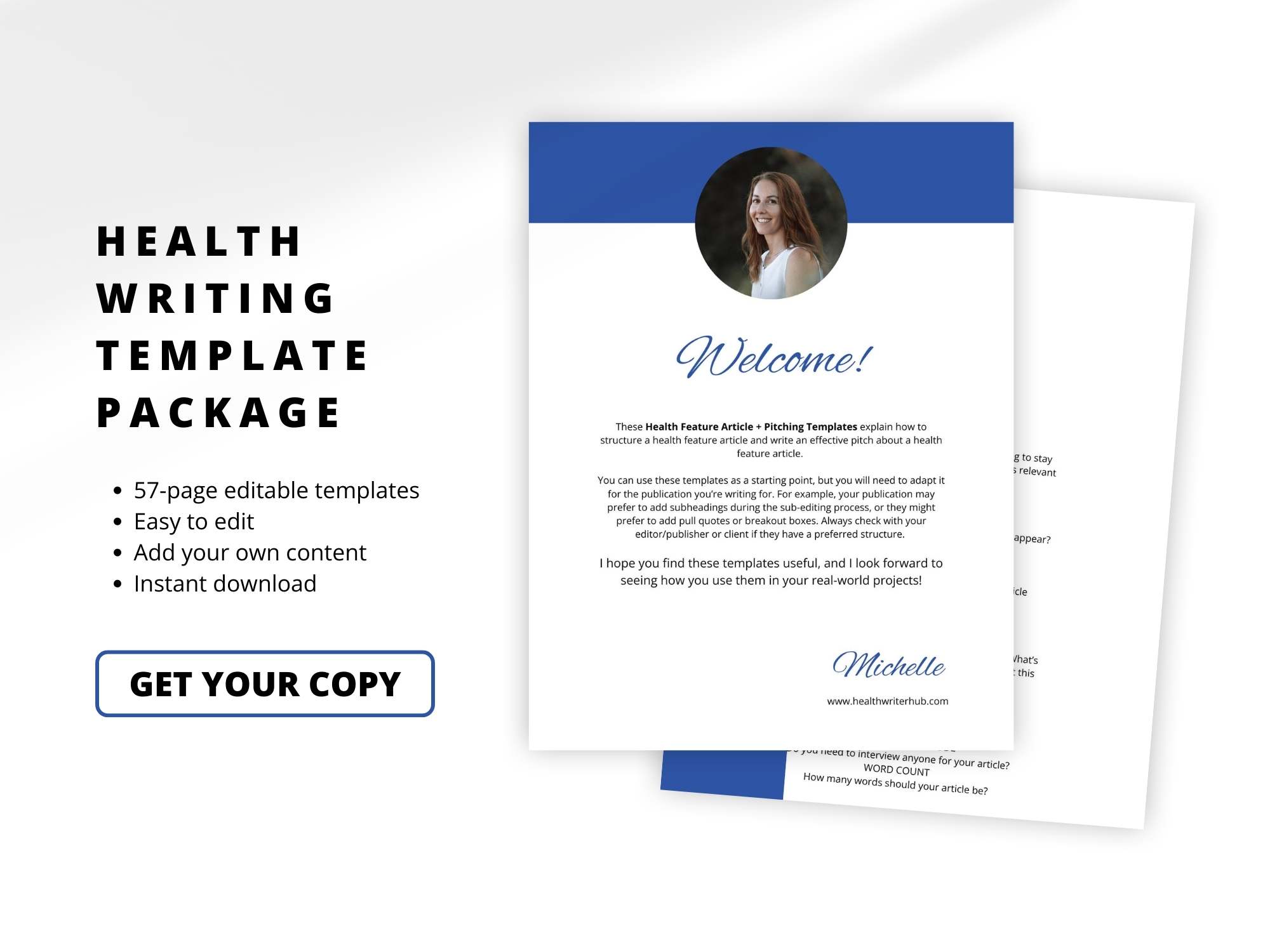
Our Health Writing Template Package includes templates for health articles, pitches, patient handouts, health blogs, medical news articles and medical writer CVs. Use these templates as a starting point to write your health content and simplify your writing process!
Example #4: Random capitalisation, irrelevant pitch
Hello Editor,
My name is Smith and I am a freelance writer, blogger, and digital media journalist and has a management degree in Supply Chain & Operations Management and Marketing and boasts a wide-ranging background in digital media. I cover health, medicine, psychology and neuroscience, drug, Chronic Pain, brain and behavior, as well as what influences the decisions we make about our health, and how the media helps and hinders people’s understanding of health issues.
For my writing references, I would like to share my last post, please find link below: ’15 famous personalities and their battles against drug addiction’
Kindly review and let me know if I can writer post for the website. Hoping for your positive response.
Thank You, Smith
How to pitch a guest post in a credible, authentic way
Guest post spam shouldn’t put you off guest blogging.
If you’re interested in guest posting, but don’t want to get chucked in the slush pile with those aforementioned emails, here are some methods that may help. They’ve worked for me:
- Personalise the email – take the time to find out who is running the show, and address the email to them directly
- Explain who you are – describe yourself in an authentic way, link to your personal website/LinkedIn profile and make sure it includes a photo and explanations of who you are and what you do
- Pitch a relevant topic – find websites that accept health article pitches, work out the topics and subjects they specialise in and pitch a relevant idea
- Get the website name right – make sure you have spelled the name write, including spaces (eg Health Writer Hub not Healthwriterhub)
- Make your intentions clear – why do you want to submit a guest post? If you openly and honestly explain the resons for your pitch, there are no secrets or hidden agendas
- Don’t make link-building the only reason for your guest post – there are other, more valuable ways to get something out of guest blogging, eg building your profile, getting published experience, sharing your knowledge with a wider audience, promoting a particular service you offer, helping others – having a link back to your website or blog can be a benefit of guest blogging, but it doesn’t have to be the only reason why you’re doing it.
Dealing with guest post spam
I find the easiest way to manage these emails is to delete, flag as junk, and carry on with my day.
Flagging them as spam or junk helps me to feel momentary relief, but unfortunately, it never stops the tirade of emails. I’ve now accepted these spammy emails are an unfortunate part of operating a business – along with that other type of ‘SEO from $99/Web Design & Development’ spam.
I haven’t ever replied to any of the spammers. Every once in a while I write an irate response, but I never end up sending it. I’m not even sure if there’s a real person on the other end of the email.
Have you ever replied to a spammer?