
 Medical communications positions that involve public relations, copywriting, or regulatory writing often require a skills test as part of the interview process.
These attempt to gauge your current writing ability and the format depends on the job. In my experience, writing tests usually involve interpreting clinical study results. Here’s what I’ve written about in the writing tests I’ve completed.
- Headlines – I wrote catchy headlines and summary paragraphs to communicate clinical study results.
- Essays – I wrote a plain language essay summarizing a 25-page medical textbook chapter.
- Abstracts – I wrote an abstract for a 10-page clinical study.
- PowerPoint slides – I created a slide deck to present clinical study results to an audience of physician specialists.
- Articles – I wrote an article summarizing clinical study results using charts and tables.
- Editing – I edited a plain language document intended to educate patients about a disease state.
Should you say yes to the writing test?
Both freelance and full-time health writers have been asked to do writing tests to showcase our skills, and we can choose to accept or decline. Experts are justified in refusing a writing test – a polished portfolio speaks for itself.
If you’re looking for an entry-level medical writer job or are early in your journey you may not have lots of health writing opportunities yet. There is nothing wrong with saying yes to a writing test at this stage.
Do an unpaid test – if you have time
A paid test is preferable and shows respect for your time, but isn’t always an option. When applying to a health writing position at a large agency, the interview process is often set in stone. You can still set a few boundaries, though, like checking that the materials are old enough (at least 5 years) to assure you aren’t doing free labor.
Keep the scope small
You can choose how much time and research to put into a test. One took me 2 hours, and another took me more than a week. The timeline depends on your learning curve and other work you are juggling. As writers who work to deadlines, we know that quick can still be good.
Showcase your talents
Instead of viewing a writing test as a deliverable for a client, think of it as a springboard for showing off your best skills.
You have a good command of grammar. If you know how to use a semicolon 3 different ways, do it. Write sentences that use commonly confused words like affect and effect to show you know the difference.
You are creative. If you are poetic and great at plain language analogies, include one. Use your artistic talents to create a beautiful infographic if that is within the scope.
Your research skills are excellent. Weave in situations where you can properly cite articles and webpages to show off your expertise.
You have good attention to detail. Make a nuanced graph that shows your ability to communicate data with clarity using formatted footnotes and superscript text.
Use free resources to improve your writing sample
Your writing talent looks better with resources to back it up. Unless you are employed by a large health system, clinical resources are expensive. You can use the free ones for now.
Find prescribing information quickly. Depending on the scope, Epocrates and DAILYMED are good supplements to official prescribing information.
Search drug approvals. Search FDA databases and Drugs.com in addition to press releases directly from drug developers.
Use disease state overviews. Conference presentations and continuing education programs are great refreshers about a disease state. As a pharmacist, I find PharmacyTimes helpful. You can also find these by searching YouTube and Google for slide decks.
Read guidelines. Guidelines for disease states like cancer and heart disease are often available for free, so search for organizations that publish current versions.
Double check grammar and style. The Purdue Online Writing Lab and Grammarly blog have a lot of useful, free grammar examples.
Find open access primary sources. Filter a PubMed search for free full text articles, and keep a list handy with open access journals like BMJ Open and The Lancet open access.
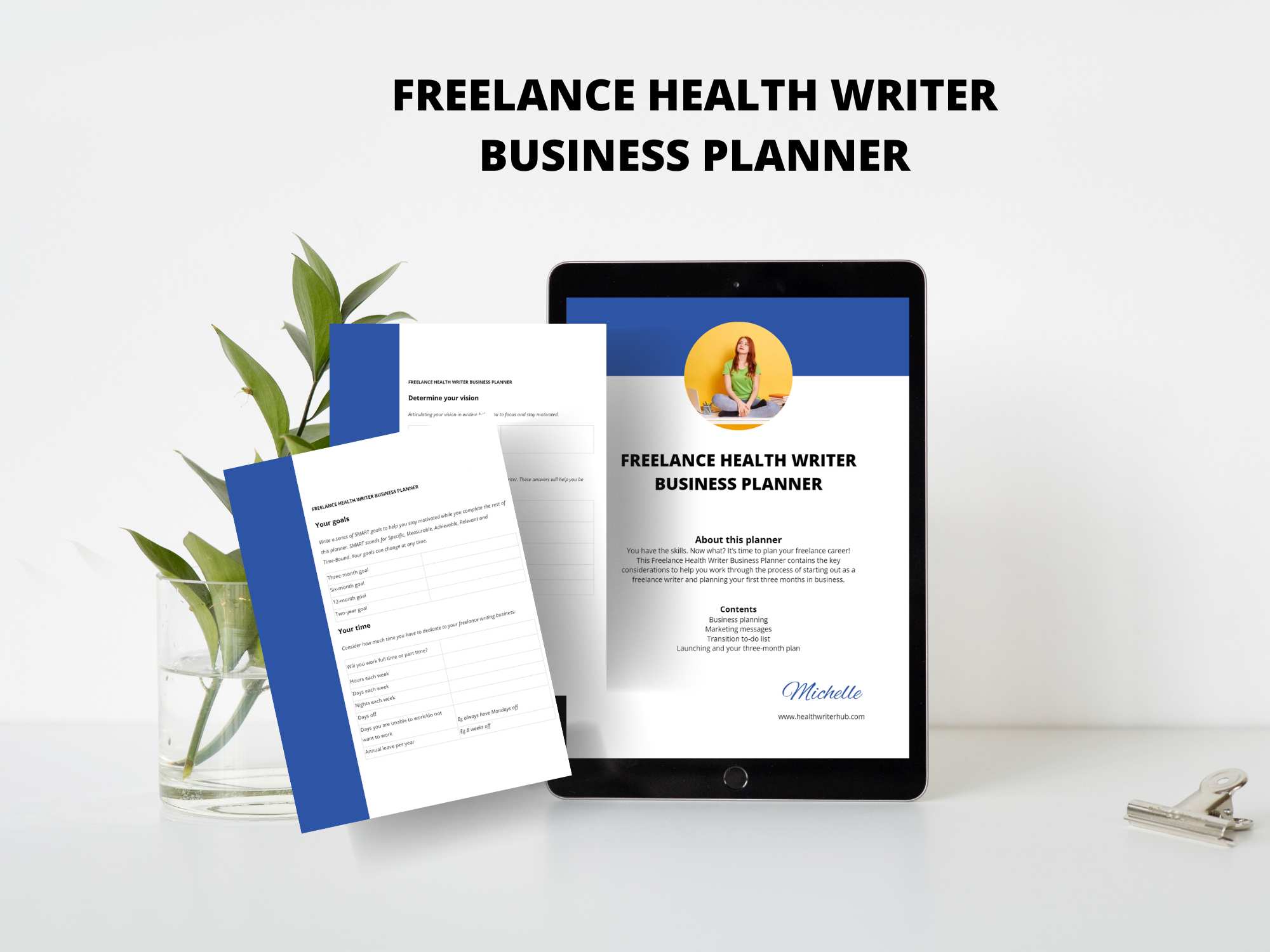
You have the skills. Now what? It’s time to plan your freelance health writing business launch!
If you want to become a freelance health writer but aren’t sure how to get started, this Freelance Health Writer Business Planner is the tool you need.
The planner helps you determine your career transition plan, marketing messages, target clients, writing services and more!
View the writing test as a learning experience
Ideally, the test will lead to a job or new client for your health writing business. If not, it can still be time well spent. Add a writing sample to your portfolio based on what you learn.
Teach yourself new software. I learned how to make a linked table of contents in Microsoft Word, use AMA formatting in Endnote, and build an original PowerPoint template.
Embrace your learning style. Instructional videos on YouTube are a great resource. I find it most helpful to create a sample alongside video instructions, but learning styles vary a lot. You might prefer reading an article or taking an online class. Try Coursera, EdX, Lynda, or a class with direct feedback like the Health Writer Hub class I took.
Ask questions. Tap into your health writer network for recommendations about the genre you are learning. You can also directly ask the recruiter or hiring manager. I usually receive helpful information in response to my questions.
Learn the communication style of your prospective client or employer. Are they fostering a competitive achievement atmosphere or a collaborative community? You may already know which work culture best fits your style.
Stay cool under pressure
If you get frustrated, don’t give up. Carve out time to step away and proofread with fresh eyes before sending it. If you are asked to revise something, give it a shot. Whether or not you get the job, the experience and knowledge are yours to keep.