If you’re writing patient education materials, it’s helpful to cut out syllables in your text for better readability.
Using one and two-syllable words is one of the most important principles of medical writing in plain English.
Why are multi-syllable words hard to read?
Multi-syllable words, also known as polysyllabic words, are hard to read because they increase the complexity of your text.
Some people may find it hard to read and understand these complex words, like:
- People with learning disabilities
- People with poor language understanding and/or processing
- People with low health literacy skills.
Multi-syllable words also make it more difficult for an average reader to skim, scan and understand the text.
Not only are long words hard to read – but they also beef up your readability score.
Readability is the ease at which someone can skim, read, understand and action your text – it’s a marker of how easy it is to read your writing.
In general, your text’s readability depends on:
- The complexity of your vocabulary and syntax
- Presentation – font size, line height, character spacing, sentence length, paragraph length.
These days, there are dozens of readability tools out there you can use to check your text’s complexity.
Most tools count the syllables in your text and encourage you to cut out syllables to make your text easier to read.
Readability tools can check how easy it is to read your work, based on:
- Syllables
- Sentence length
- Passive voice
- Sentence structure
- Word frequency.
How to cut out syllables and improve your text’s readability
To improve readability, the idea is to cut out as many multi-syllable words as you can – not every single word. You’ll still need to include some three, four or five-syllable words.
And once you get going, you’ll see there are plenty of opportunities to cut out long words (more than you think).
I’m now going to show you how to remove syllables to improve readability as I work through a patient handout project about stroke (using the SHeLL Editor).
Before editing: Readability grade 10.6
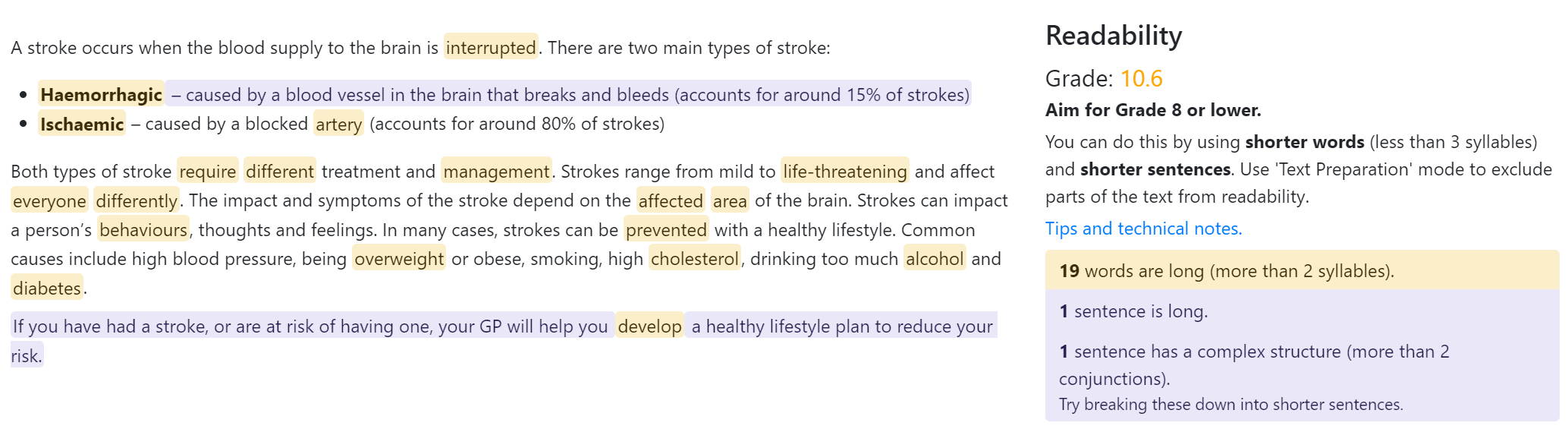
This first draft has a reading level of 10.6 and I’m aiming for 8 or under.
There are no long sentences. However, one of my sentences has a complex structure (more than two conjunctions).
But really, what is making this copy score so highly is the amount of multi-syllable words.
If I can edit those words and phrases to be two syllables or less, my copy should score well under 8.
So here we go!
After editing: Readability grade 7
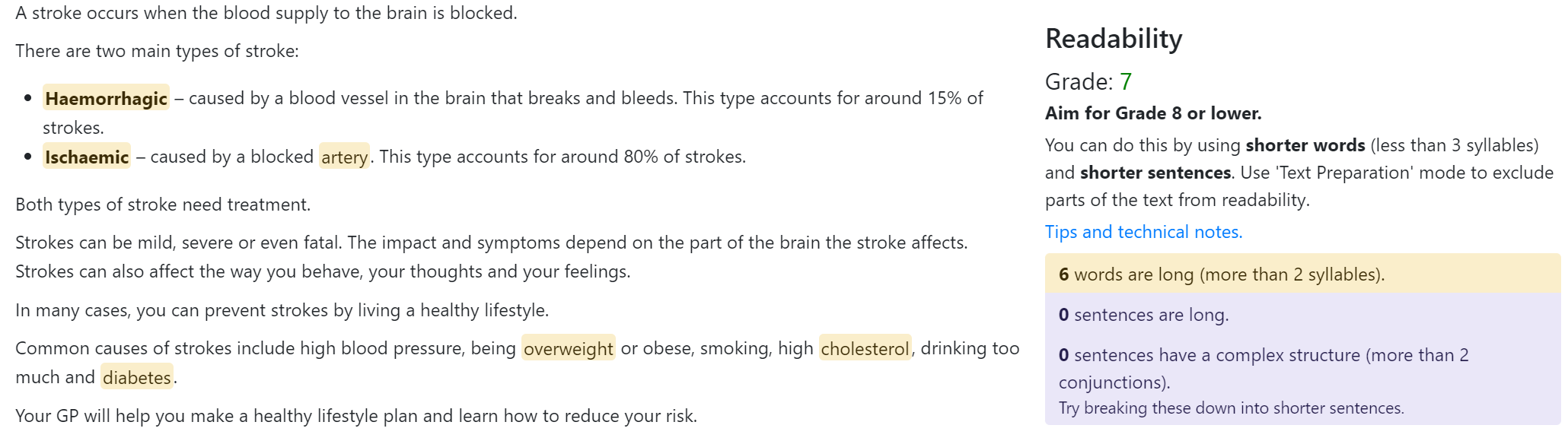
You can see that the grade is now 7. Hooray!
I’ve also gotten rid of both those pesky long purple sentences.
Cutting out syllables for better readability: The line-by-line analysis
So, let’s look at the edits I made, line by line.
| OLD COPY | NEW COPY | WHAT I DID |
| A stroke occurs when the blood supply to the brain is interrupted. | A stroke occurs when the blood supply to the brain is blocked. | Changed interrupted to blocked. |
| There are two main types of stroke: | There are two main types of stroke: | OK – no change needed. |
| Haemorrhagic – caused by a blood vessel in the brain that breaks and bleeds (accounts for around 15% of strokes) |
Haemorrhagic – caused by a blood vessel in the brain that breaks and bleeds. This type accounts for around 15% of strokes.
|
Split this long bullet point into two sentences. |
| Ischaemic – caused by a blocked artery (accounts for around 80% of strokes) |
Ischaemic – caused by a blocked artery. This type accounts for around 80% of strokes.
|
Edited this bullet point for consistency as above. |
| Both types of stroke require different treatment and management. |
Both types of stroke need treatment.
|
Simplified the sentence and deleted the 3-syllable word management. |
| Strokes range from mild to life-threatening and affect everyone differently. |
Strokes can be mild, severe or even fatal.
|
Needed to get rid of life-threatening and differently, so I edited the sentence. |
| The impact and symptoms of the stroke depend on the affected area of the brain. |
The impact and symptoms depend on the part of the brain the stroke affects.
|
Rewrote the sentence to change affected to affect. |
| Strokes can impact a person’s behaviours, thoughts and feelings. | Strokes can impact the way you behave, your thoughts and your feelings. | Edited out the 4-syllable word behaviours. |
| In many cases, strokes can be prevented with a healthy lifestyle. | In many cases, you can prevent strokes by living a healthy lifestyle. | Reduced the passive voice and edited the 3-syllable word prevented to prevent. |
| Common causes include high blood pressure, being overweight or obese, smoking, high cholesterol, drinking too much alcohol and diabetes. | Common causes of strokes include high blood pressure, being overweight or obese, smoking, high cholesterol, drinking too much and diabetes. | Got rid of the word alcohol but left a few multi-syllable words in for accuracy and lack of good alternatives. |
| If you have had a stroke, or are at risk of having one, your GP will help you develop a healthy lifestyle plan to reduce your risk. | Your GP will help you make a healthy lifestyle plan and learn how to reduce your risk. |
Reduced the long sentence. |
The final word
Removing syllables isn’t the only readability technique to know. But it’s one to start using from now on when you’re ensuring your content includes all the rules of plain English writing.
Being aware of your syllable count also forces you to be more creative with your writing which benefits your skills in the long term.
So, try to include shorter words when you’re writing your next patient handout – it’s not as tricky as you think!